« Previous object
Next object »
ID# 20
IGR J17494-3030
Swift J17494-3030
RA Dec
|
ℓ b
|
Year of discovery: 2012
(Boissay2012)
| Location in Globular Cluster | ||
|---|---|---|
| Type of accretor |
NS AMXP (376.05 Hz / 2.66 ms) |
Transient Ng2021 |
|
Distance [kpc] (other distances) |
assumed 8
|
ArmasPadilla2013c |
| z [kpc] | -0.21 | ArmasPadilla2013c |
| Orbital period (Porb) [min] | 74.9445±0.0005 | Ng2021 |
| Porb determination method | X-ray pulsation | |
| Thermonuclear X-ray burst | ||
| Peak X-ray flux [erg s-1 cm-2] (2 - 10 keV) |
9.35E-11 | ArmasPadilla2013c |
| NH [x1022 cm-2] | 1.87 | ArmasPadilla2013c |
| E(B-V) [mag] | ||
| Magnitude | ||
| Proposed companion | (likely to be a ~0.02solar mass finite-entropy He or C/O Wd) (donor mass-radius constraint) |
Ng2021 |
| The radio counterpart was likely detected during the 2020 outburst (4.5 GHz; VanDenEijnden2020b). Rojas2012 identified five potential candidates for the quiescent NIR counterpart. The source was not detected in quiescence after the 2012 outburst with Chandra (Chakrabarty2013). |
| UV | ||
|---|---|---|
| Optical | ||
| X-ray | Featureless | ArmasPadilla2013c |
|
|||
|---|---|---|---|
Aladin finding chart
Scroll to zoom. Set survey image in "Manage layers"
Default image: DSS2 Red
IGR J17494-3030 in Simbad
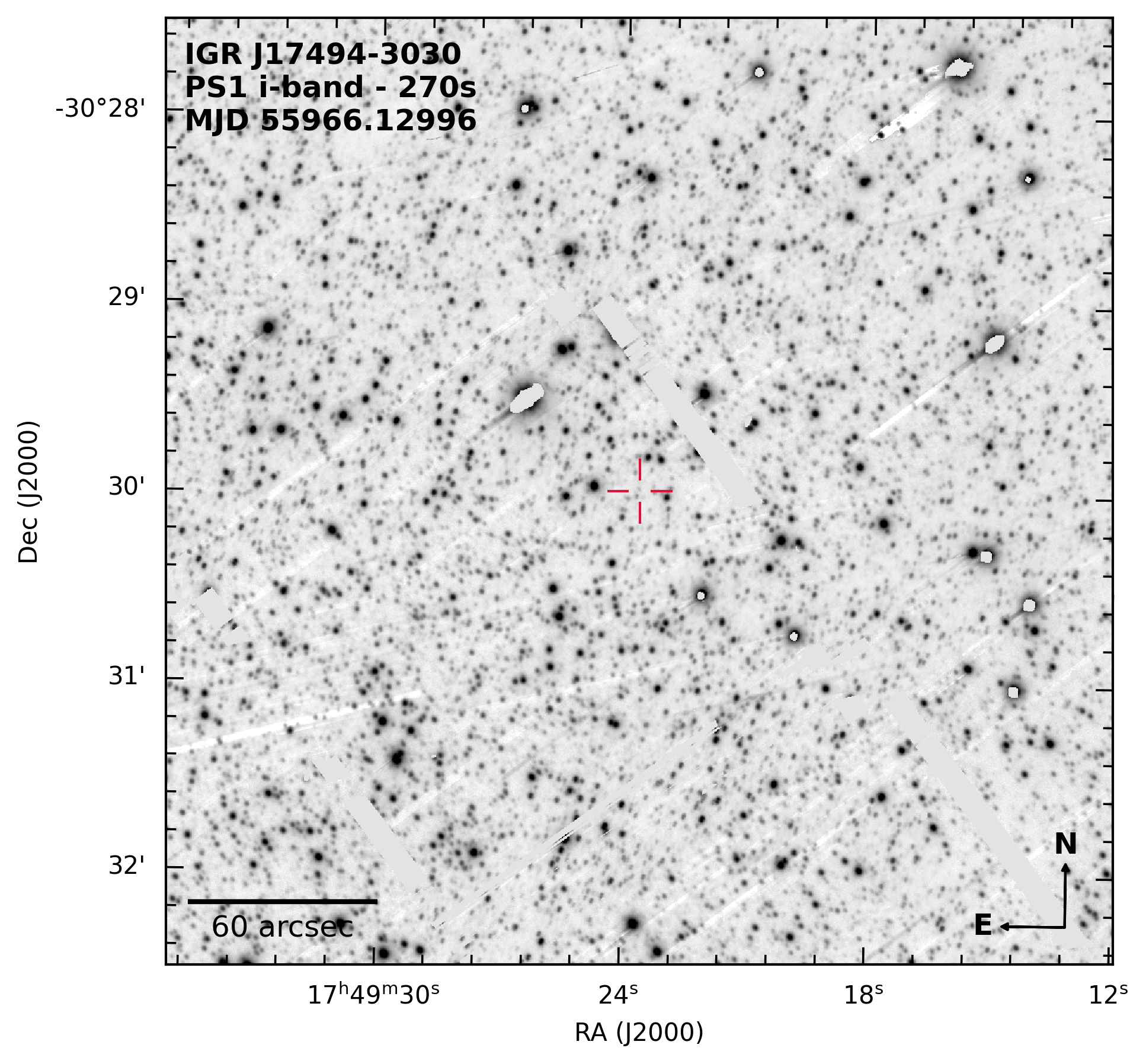
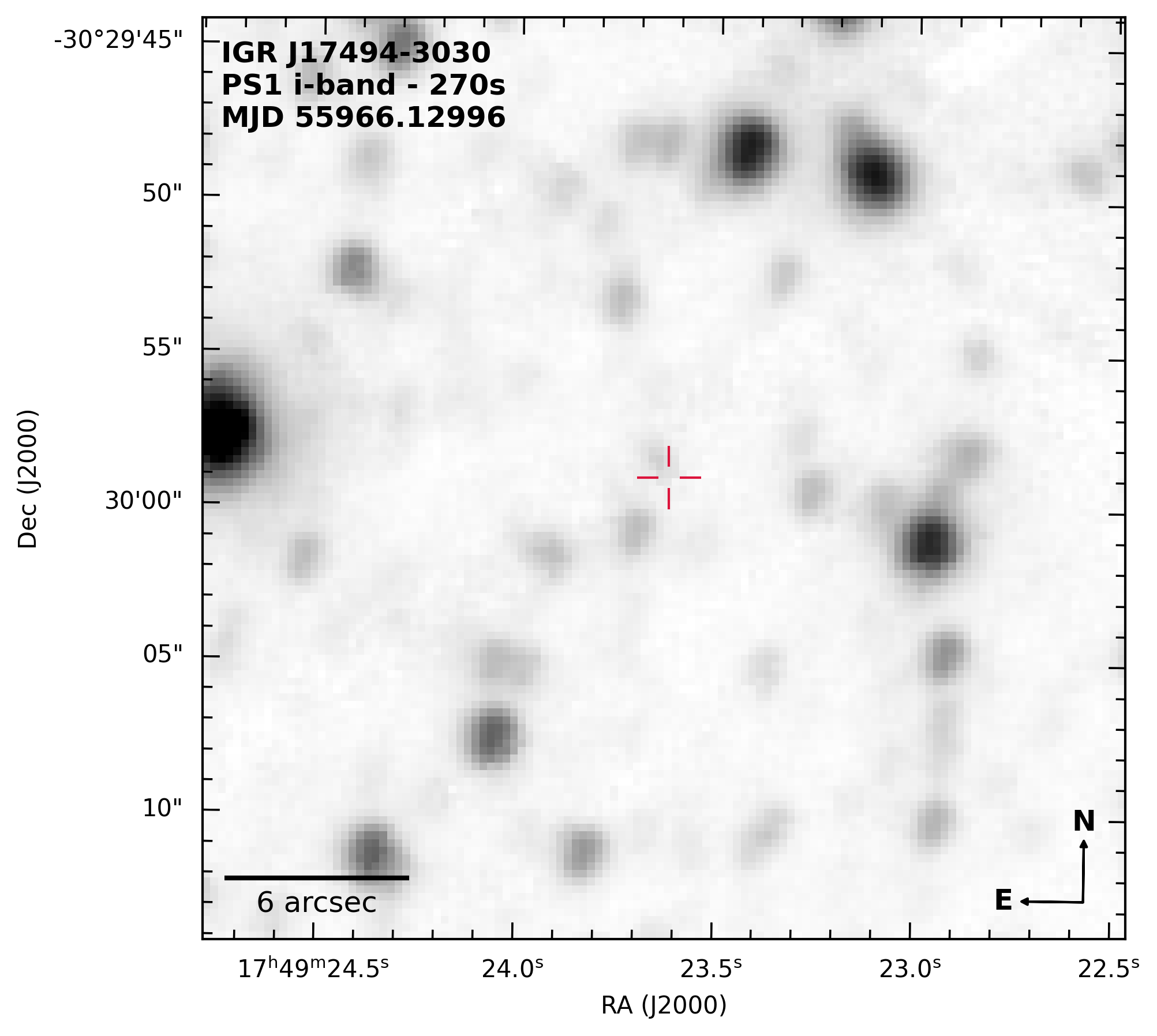
Pan-STARRS1 finding chart
Click to enlarge in new tab/window
This research has made use of NASA's Astrophysics Data System (ADS) and the SIMBAD database operated at CDS (Strasbourg, France)
Please acknowledge the use of this catalogue in any published work you derive from it.
Last modified: 09 May 2023.
Mirrors:


UltraCompCAT acknowledges support to the Spanish Ministry of Science under grants PID2020–120323GB–I00, to the Consejería de Economía, Conocimiento y Empleo del Gobierno de Canarias,
and the European Regional Development Fund (ERDF) under grant with reference ProID2021010132